



Tannins are a heterogeneous group of polyphenolic polymers distinguishable into three main groups: hydrolyzable tannins (THs), condensed tannins (TCs), and phlorotannins (FTs). TH and TC compounds are found in plants and represent the classes of natural substances on which research has focused due to their effects on parameters of ruminal fermentation, microbiota, biohydrogenation, protein precipitation, milk production, and composition.
Tannins occur naturally as secondary compounds in plants and are present in many forages consumed by ruminants. Plants act as a reservoir of specialized metabolites, derived from secondary metabolism, making them a renewable source of bioactive compounds that can be used in various ways for animal health and well-being.
Secondary plant compounds are biologically active molecules not involved in primary biochemical processes such as plant growth, development, and reproduction. Most of these compounds have biological activity on microorganisms, affecting their growth rate, and also cause effects on animal metabolic processes, as is the case with tannins.
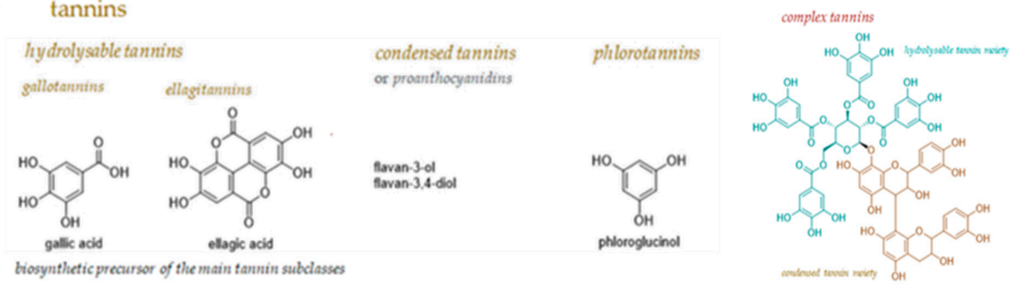
According to Figure 1, hydrolyzable tannins are polyphenolic compounds that can be hydrolyzed in the presence of water, producing phenolic acids and sugars. They are mainly composed of gallic acid or ellagic acid and sugars. Condensed tannins, also known as proanthocyanidins, are formed by the condensation of flavonoids, specifically catechins and epicatechins, and are not hydrolyzed in the presence of water.
Studies on plant extracts and secondary metabolites (tannins, essential oils, saponins, flavonoids) in ruminant diets highlight the need to use compounds to control specific microbial populations in order to modulate ruminal fermentation. Therefore, they represent natural alternatives with great potential to increase livestock productivity and reduce environmental pollutants such as methane (CH4) and CO2, phosphorus, and nitrogen in manure.
Therefore, research on the use of tannins focuses on elucidating the systemic effects of supplementation in ruminants, as the literature presents a diversity of results depending on the type, quantity consumed, compound structure, molecular weight, and physiological state of the consuming species. Among the variables that directly influence animal performance and the possibilities of tannin use, such as delivery method, dosage, and product presentation (liquid, microencapsulated, molecular structure), this article presents some considerations from the scientific literature on the use of tannins in ruminant feed.
Tannins and the modulation of the rumen microbiota
To understand the action of tannins in the rumen, it is first necessary to remember which microorganisms make up the bacterial community of a ruminant. This composition depends directly on the species, type, and chemical composition and/or frequency of the diet. In all ruminants, the bacteria belong to the phyla Firmicutes, Bacteroidetes, Proteobacteria, Fibrobacteres and, in a smaller number, Tenericutes and Actinobacteria. Their classification generally takes into account the relative food substrates, so that one can distinguish between cellulolytic, amylolytic, proteolytic, lipolytic, methanogenic, saccharolytic, tannin-lytic, pectinolytic, ureolytic, acetogenic and acidogenic bacteria.
The three main cellulolytic bacteria found in cows and other ruminants are Fibrobacter succinogenes (Gram-), Ruminococcus flavefaciens (Gram+), and Ruminococcus albus (Gram-variable), whose end products of fermentation consist mainly of acetate, butyrate, propionate, and CO₂.2. The most important pectinolytic species in bovine metabolism are *Lachnospira multiparus*, capable of reducing pectin to oligogalacturonides, providing a large amount of acetate, *Prevotella ruminicola*, and *Butyrivibrio fibrisolvens*. Proteolytic bacteria in the rumen, such as *Clostridium*, *Bacillus*, and *Proteobacteria*, break down proteins into smaller peptides, while lipolytic examples include *Anaerovibrio lipolytica* and *Butyrivibrio fibrisolvens*. Other microorganisms make up the bacterial community: protozoa and anaerobic fungi, which are important because they are involved in the degradation of lignocellulosic components.
Methanogenic archaea constitute the largest part of the methanogen community in most ruminants, where research has focused on understanding how possible dietary intervention and the relationship with other microorganisms can modify CH4 emissions.4. Examples of methane-producing genera include Methanobacterium, Methanobrevibacter, Methanosphaera, and Methanothermobacter.
Methane arises from the fermentation of food in the rumen (87–90%) and large intestine (10–13%) of ruminants through the action of methanogenic archaea. Methanogens reduce CO2.2 CH4 Using hydrogen during the final stage of microbial fermentation in the rumen. From the perspective of reducing methane production, tannins, in turn, can act directly or indirectly in the rumen. The indirect action is due to their effects of reducing the degradability of plant material. The direct effect occurs on methanogenic microorganisms, inhibiting their activity. In addition, they can reduce the accessibility of methanogens to H₂ by favoring the increase of propionate, a gluconeogenic precursor, whose fermentation pathway, unlike other VFAs, does not lead to the release of hydrogen. Therefore, the decrease in methane production through the use of plant extracts rich in tannins can be justified by a direct reduction or inhibition in the population of protozoa and/or methanogens, inhibition of fibrinolytic enzyme activity, feed digestibility, and alterations in the profiles of VFAs (volatile fatty acids), which are involved in different metabolic pathways and can lead to macroscopic effects in the animal.
Furthermore, tannins have an affinity for binding to dietary proteins and, therefore, can reduce excessive protein degradation in the rumen and increase availability for absorption in the intestines of ruminants. Excess protein in the diet of ruminants, consumed through pasture or unbalanced diets, is degraded into ammonia in the rumen and, at least in part, is not used by microorganisms. The ammonia needs to be metabolized in the liver and is largely excreted as easily volatile urea through the urine. Thus, excess protein in cattle diets is a burden on metabolism and the environment.
Thus, dietary supplements that provide the desired effect on reducing proteolysis in the rumen and increasing the availability of this protein in the abomasum are viable and promising alternatives, as is the case with chestnut extract (Castanea sativa), which is composed mainly of hydrolyzable tannins. In an in vitro assay, it was observed that chestnut extract reduces ruminal protein degradation without influencing microbial protein synthesis. In vivo, researchers found that supplementation with chestnut extract reduced N losses and methane emissions from dairy cow manure. Concomitantly, milk production was not negatively affected, and no toxic effects or decreased feed intake were reported in dairy cows.
One way to assess the effect of tannins is through purine derivatives in urine, which allow us to estimate the amount of rumen microbial protein produced and digested in the duodenum, since they originate mainly from rumen microbial nucleic acids and their derivatives. Urinary N concentrations and excretion in ruminants depend in part on the amount of ammonia formed in the rumen, which increases with excess protein available in the diet relative to energy supply. With reduced protein degradation in the rumen, other effects can be observed, including reduced N excretion into the environment, suppression of intestinal parasites, improved immune responses, reproductive efficiency, and a slight increase in milk production.
In the literature, the biological response of tannin interaction with microbiota is determined by the dose level considered. Hydroalcoholic extracts of chestnut (Castanea spp.), sumac (Rhus typhina), mimosa (Mimosa tenuiflora), and quebracho (Schinopsis balansae), all supplemented at a dosage of 1 mg, inhibited methanogens, while at different doses they exhibited different behaviors against Fibrobacter succinogenes, Ruminococcus flavefaciens, and anaerobic fungi.
Tannins: palatability and concentration in the diet
Tannins have been present in the diet of cattle for thousands of years, ever since plants developed this defense mechanism against predators and microorganisms. An interesting fact about this is that, despite being present in the diet of cattle for so long, their effects on dairy cattle are not fully understood, with great variability in the results of experiments testing different levels of tannin inclusion in diets.
Much research reports that tannins in their pure form can cause the development of conditioned aversion to foods due to their astringent taste. Therefore, an important point to consider when offering tannins to animals is how they are offered. This aversion effect to tannin-rich foods is related to the production of proline-rich proteins (PRPs) in saliva, which are able to bind to dietary tannins to inactivate them. It is the binding of these proteins to tannins that produces the astringent taste and subsequent development of food aversion. Cattle and sheep lack PRPs, therefore the decrease in dry matter intake due to the astringent taste mechanism associated with tannins may not occur in sheep and cattle. However, other proteins are present in the saliva of cattle fed diets rich in tannins, which have a high affinity for tannins but are not rich in proline; these salivary proteins tend to form tannin-protein complexes.
Furthermore, the composition of the diet directly influences the behavior of tannins in the gastrointestinal tract, with several authors reporting that the results or development of aversion effects to diets and reduced dry matter intake depend on the forage or concentrates used. In lactating cows, for example, that consumed Lotus corniculatus (Forage containing tannins) showed higher dry matter intake and lower methane excretion per liter of milk compared to cows fed ryegrass silage (PUCHALA et al, 2005). Other authors, such as Woodward et al. (2001) and Carulla et al. (2005), reported increased dry matter intake with supplementation levels of 2,59% and 2,50% of quebracho tannins in the diets.
Regarding the effects on milk production, studies have revealed that the effect of protein precipitation through tannin ingestion, causing a reduction in its degradation in the rumen by the microbial population, resulted in increased milk production in cows (WOODWARD et al, 1999), dairy goats (ROUISSI et al, 2006), and sheep (PENNING et al, 1988). Concomitantly, different doses used by the cited authors yielded different results, reinforcing that the use of tannins is influenced by the animal species, environment, diet composition, type and doses of tannins, physiological state of the animals, among other factors, ensuring the need for constant technical monitoring to achieve the expected results.
A key issue when using plant extracts as food additives is dosage. The lack of standardization between analyses and the use of different standards to express tannin concentrations mean that comparisons between experiments can rarely be made with reasonable confidence.
Similarly, just as dietary tannin concentrations can affect milk production volume per cycle, milk component yield, milk fat concentrations, protein, and lactose were other factors evaluated by authors, and it was reported that they were not negatively affected by tannin supplementation. According to Aguerre et al. (2010), milk yield and fat composition were not affected by quebracho tannin supplementation up to 1.8% in dairy cow diets, and milk protein concentration increased with the inclusion of 0.45% tannins, while supplementation with 1.8% reduced milk protein concentration.
There are few studies on the impact of tannin-rich plants or extracts on the reproductive performance of adult ruminants. However, short periods of improved nutrient supply through diets containing tannin supplementation before and during reproduction have been shown to influence ovulation rate. These periods also increased follicle size and/or number, reduced follicular atresia, altered plasma gonadotropin concentrations, and increased ovarian sensitivity to gonadotropins. These effects may be related to changes in body weight and condition, energy and protein intake and small intestine protein absorption (related to tannin supplementation), plasma concentrations of essential amino acids, and plasma metabolic hormone levels, especially insulin.
The effect of tannins on reducing embryonic losses may be associated with their ability to precipitate proteins and their availability in the rumen, since a large part of dietary protein is hydrolyzed in the rumen into ammonia, some of which is reincorporated into microbial protein. Excess ammonia is absorbed from the rumen and metabolized into urea in the liver, leading to an increase in plasma concentrations of ammonia and urea, which can increase the number of early embryonic losses. In general, the supply of tannins in low concentrations has positive effects on the reproduction of dairy cows.
In conclusion, technical support is extremely important for monitoring the use of tannins, as the effects on modulating rumen fermentation, nutrient utilization, and ruminant performance are likely due to the great diversity in the structural characteristics and, consequently, the reactivity of these compounds. Correct dosage selection is another important issue due to the difficulty in selecting concentrations that positively affect a specific parameter without causing a negative response in others. Count on our team of experts to find a solution that best suits your production realities. Contact us. Contact us Learn more about the hydrolyzable tannin solutions available in our portfolio.
Complementary feed for dairy cows
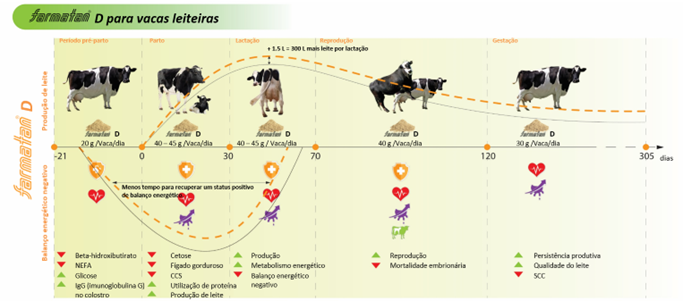
Farmatan D is a combination of ellagitannins and essential oils that promotes the reduction of ruminal protein degradation and increases the utilization of feed proteins, promoting increased milk production, improving milk quality and liver health with a lower protein inclusion in the feed. Farmatan D also promotes a decrease in the number of Clostridia spp. in the digestive system, positively shaping the bacterial population.
Stay up to date! Visit our LinkedIn.